Read your messages
It sees who a notification came from and which app sent it. Not a word of what's inside. There's no messaging permission anywhere in the app, so this isn't something we could quietly change our minds about later.
Calls · Texts · Notifications
Now eleven numbers you've never seen are ringing, two of them twice a day, and the texts started on Thursday. Doorman answers the door so you don't have to, and it writes down everyone who knocked.
Not released yet. Doorman is in private testing. Join the list and we will email once, when there is a build worth installing.
It never reads your messages, never uploads anything, and never asks for your contacts.
Eleven numbers reached the door.
Not one of them made a sound.
Three were expected. Those got through.
And every one of the eleven was written down.
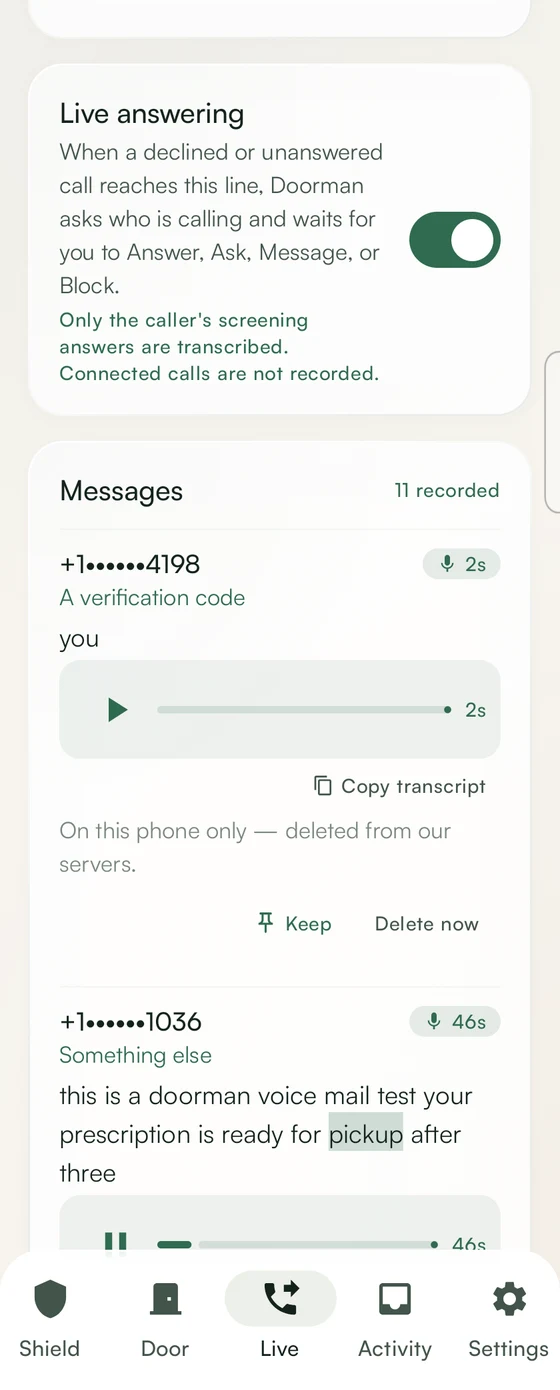
The other apps here make a judgement and then say nothing about it, which is why their reviews are full of people who missed something and found out days later. You get the reason for every single one — the ones that were held, and the ones that rang.
The screens below the fold in this section are unretouched captures from the Android build, cropped only to remove the phone's own status bar. The callers come from the app's test lab, which runs synthetic calls through the real decision engine — publishing a stranger's number to sell software would be a strange way to argue that we take yours seriously.
These aren't promises buried in a privacy policy. They're just what happens when an app doesn't hold the permission in the first place.
It sees who a notification came from and which app sent it. Not a word of what's inside. There's no messaging permission anywhere in the app, so this isn't something we could quietly change our minds about later.
By the time a notification reaches Doorman, Android has already swapped in the contact's name if it knows one. A name means someone you know, a bare number means a stranger, and that's the whole test. It needs your address book about as much as a doorbell does.
A held text keeps its place in your notification shade. A held call still turns up in your call log. There's no code path in the app that can suppress either one, and a test checks for that on every build.
Codes come from five-digit senders and nobody has one of those saved, so a shut door holds them like anything else. Tap once and messages open to everyone for ten minutes, then it shuts itself again whether you remember to or not.
This is the part most filters get wrong. They make you choose between a quiet phone and being able to log in to anything.
Messages open to any sender. Closes on its own.
One switch. People in your contacts still get through, alarms always do, and everything else waits its turn.
Expecting the roofer? Add the number before they ring. Every other app here makes you wait to be bothered first and block them afterwards.
Twice a day it tells you what knocked. That's the only time it ever interrupts you, and you can switch even that off.
Nearly all of them were about billing. So the part that costs us nothing to run isn't a subscription.
Calls to your own number, held and shown with the reason. Free, and staying that way.
Texts, app notifications and the log. You pay once and that's the end of it. Fourteen days free first, and nothing happens on its own when they run out.
A number we answer for you, so your voicemail stays empty. A subscription, because we rent a real phone number for you every month. It is not finished, so you cannot buy it yet and we would rather say so than take the money early.
Android first. No ads, no analytics, nothing sold, and a test that fails the build if anyone adds any.
Early access
Not a newsletter, not a drip sequence, not a launch countdown. One email, on the day there is a build worth putting on your phone. If you would rather not be on a list at all, that is a reasonable position and the how-it-works page tells you everything this one would.
We keep the address and the date you gave it. Nothing else, and it goes nowhere else — what that means.